TL;DR — Key Takeaways
- When a user asks ChatGPT "what's the best mattress for back pain," the products cited in the response capture most of the attention — and the clicks.
- A product recommended by an AI benefits from a trust bias: users perceive the suggestion as expert advice, not advertising.
- Standard e-commerce product pages (short descriptions, raw specs) are invisible to LLMs: they lack the semantic context these models look for.
- GEO (Generative Engine Optimization) adapts your product content to maximize your chances of being cited in generative AI responses.
The Buying Journey Increasingly Runs Through AI
Online buyer behavior is changing. Instead of typing "men's running shoes" into Google, a growing number of users ask ChatGPT or Perplexity directly: "What are the best running shoes for an 85 kg runner who goes out 3 times a week?"
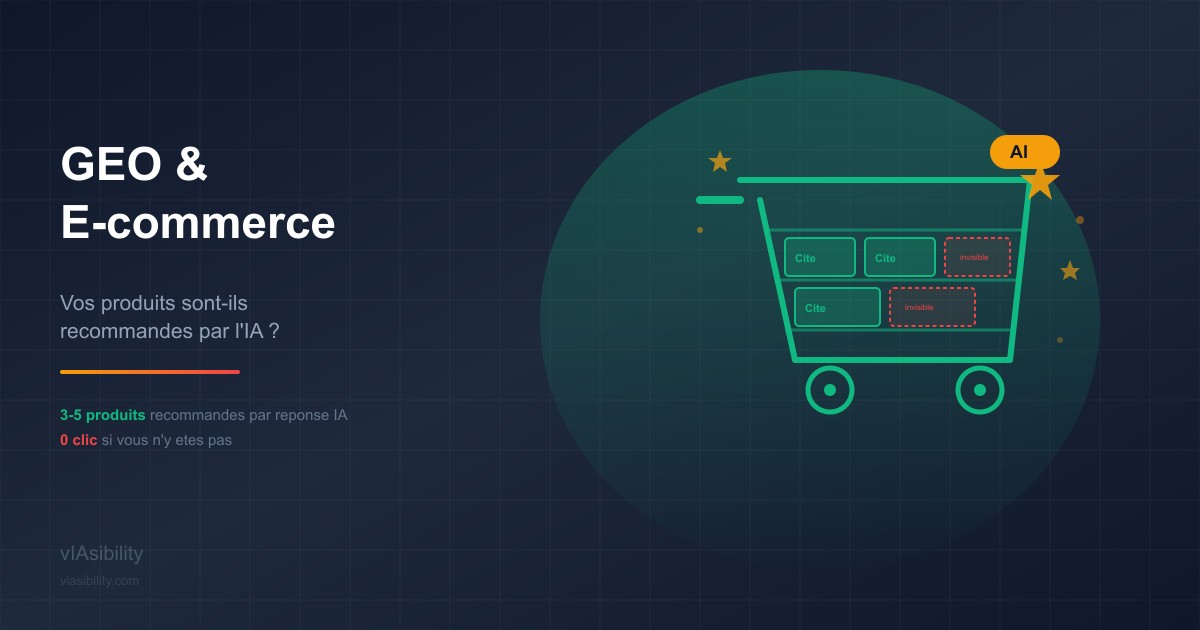
The difference is fundamental: AI doesn't return 10 blue links — it recommends 3 to 5 specific products. If yours isn't among them, you don't exist in this new acquisition channel.
According to a Semrush study analyzing 80 million clickstream data points, queries on ChatGPT Search are mostly exploratory and don't fit traditional categories (informational, transactional). 70% of prompts relate to problem-solving or brainstorming — exactly the type of query that leads to a purchase.
Why an AI Recommendation Is Worth More Than an Ad
The "Expert Recommendation" Effect
When a user receives a product recommendation from ChatGPT, they don't perceive it as advertising. They interpret it as an objective opinion, selected from thousands of sources. This trust bias is massive: the consideration rate for an AI-cited product is significantly higher than for a product displayed in a banner ad.
The Shortlist Effect
Google displays 10+ results. AI recommends 3 to 5 maximum. Being on this shortlist means your product is directly compared to a handful of competitors — not buried in a results page. For the consumer, the decision simplifies: they'll choose from what the AI suggests.
Conversational Long Tail
AI queries are naturally more specific. As shown by BDM's analysis on SEO for ChatGPT Search, users formulate contextualized requests: budget, use case, constraints. A product whose listing precisely addresses these criteria will naturally be favored by the model.
What LLMs Expect from Your Product Pages
AI engines don't read your listings like a human. They look for structured semantic signals to decide what to recommend. Here's what makes the difference:
1. Usage Context, Not Just Specs
A listing that says "Sole: EVA 38mm, drop 8mm, 280g" is useless to an LLM. A listing that says "Designed for regular runners weighing 70–90 kg, this shoe offers reinforced cushioning with its 38mm EVA sole, ideal for road runs of 10–20 km" gives the model everything it needs to recommend it in response to a specific question.
2. Complete Product Structured Data
Schema.org Product markup with offers, aggregateRating, brand, sku, and review enables AI crawlers to extract key information without ambiguity. Structured data is a fundamental lever for visibility in AI responses.
3. Customer Reviews and Editorial Content
LLMs place major importance on third-party sources. A product mentioned in comparisons, independent reviews, or Reddit discussions is far more likely to be cited than a product that only exists on your site. Combining structured reviews (Schema Review) with editorial content around your products (buying guides, comparisons, FAQs) creates the information density that models look for.
4. Freshness
AI engines favor recent content. A "Best Robot Vacuum 2026" comparison updated regularly with current pricing data will be preferred over a 2023 article.
4 Concrete Actions for E-commerce Businesses
- Enrich your product pages with usage context: for whom, what use case, under what conditions, at what budget. Think about how LLMs choose their sources when structuring your content.
- Deploy complete Product markup: price, availability, aggregate reviews, brand, SKU. Every missing field is a lost opportunity.
- Create editorial content around your products: buying guides, comparisons, "which product for..." FAQs. This content serves as an entry point for LLMs.
- Monitor your AI presence with a tool like vIAsibility to know whether your products are being cited — and especially which competitors are being cited instead.
Conclusion
E-commerce is entering a new era where being found is no longer enough — you need to be recommended. Generative AIs aren't just another channel: they're becoming the first decision filter for a growing share of shoppers. Every product not cited in an AI response is a potential sale lost to a better-optimized competitor.
GEO is no longer optional for e-commerce businesses. It's the next visibility battleground.